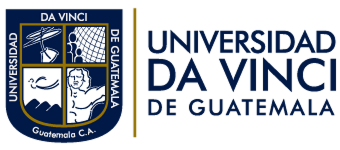
The Universidad Da Vinci de Guatemala emblem is composed of four elements whose symbolism reflects the University’s foundations, as well as its vision, mission, and objectives.
The upper-left quadrant features a stylized representation of the helicopter model developed by Leonardo da Vinci, symbolizing innovation, creativity, and the application of science to the development of new technologies and tools. Through inventions such as this, da Vinci was far ahead of his time and helped advance scientific and technological progress to new levels.
The upper-right quadrant features a stylized representation of the world and human figures. Together, they symbolize universality, one of the defining characteristics of Leonardo’s vision and a principle that also identifies Universidad Da Vinci de Guatemala. The integration of pure and applied sciences and their use for educational, cultural, scientific, and social transformation purposes—through education, research, and participation in productive activities—are elements that give the University a universal character that transcends physical boundaries.
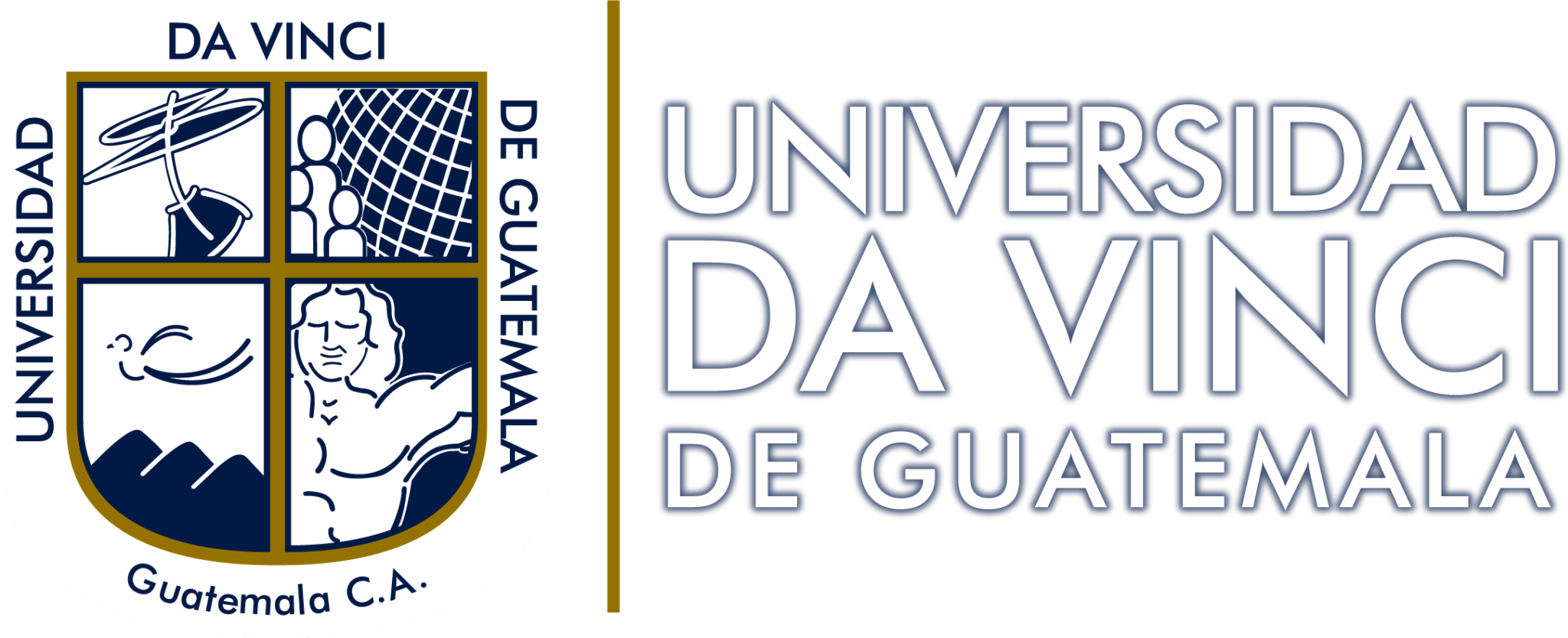
The lower-left quadrant features two stylized figures. The first represents the Cuchumatanes, one of Guatemala’s most representative mountain ranges and the highest in the country. Above it appears the Quetzal, Guatemala’s national bird and a symbol of freedom and splendor.
The lower-right quadrant features a stylized portion of the “Vitruvian Man,” an example of the holistic approach Leonardo da Vinci developed during the second half of the 1480s. For Leonardo, this representation expressed the relationship between architecture and the human body and reflected his belief that the human being was a model of the universe. He considered it essential to connect what he discovered within the human body with what he observed in nature. For this reason, the image of the “Vitruvian Man” is representative of Universidad Da Vinci de Guatemala, since the human being is at the center of the University’s activities across its various areas of action, beginning with education and connecting it with culture, scientific development, and social contribution.
Faculties
Architecture and Design
Business and Administrative Sciences
Agricultural Sciences
Medical and Life Sciences
Legal, Criminological and Forensic Sciences
Dental Sciences
Veterinary Medicine and Animal Sciences
Nursing and Health Care Sciences
Humanities
Engineering, Industry and Technology
Music and Visual Arts
Psychology